Wednesday, September 20, 2006
openModeller used in Cyclamen study
Chris Yesson and Alastair Culham (University of Reading, UK) have published a phyloclimatic study on Cyclamen a genus of popular garden plants. In the study they used openModeller (Bioclim) and MaxEnt to compute the climatic niche for members of this genus in past, present and future climates. The openModeller Desktop 'hotspot' tool was also used in the analysis. This tool will be generally available in the next version of openModeller Desktop! Full text of the article is available at the BioMed Central Website . The study also recieved mention in the popular press . Update: The study is discussed in a BBC Leading Edge radio show interview (it's right near the end). The aforementioned link needs Real Audio to be present on your computer.

Tuesday, August 29, 2006
Predicting habitat suitability with machine learning models
An article was recently published in Ecological Modelling describing procedures used to model Pine forest distribution in Spain. The authors used Grass and R to carry out the modelling process. openModeller was not used but the article is still interesting for those involved in ecological niche modelling. The complete article is available for download as a pdf document .
Abstract:
"We present a modelling framework for predicting forest areas. The framework is obtained by integrating a machine learning software suite within the GRASS Geographical Information System (GIS) and by providing additional methods for predictive habitat modelling. Three machine learning techniques (Tree-Based Classification, Neural Networks and Random Forest) are available in parallel for modelling from climatic and topographic variables. Model evaluation and parameter selection are measured by sensitivity-specificity ROC analysis, while the final presence and absence maps are obtained through maximisation of the kappa statistic. The modelling framework is applied at a resolution of 1 km with Iberian subpopulations of Pinus sylvestris L. forests. For this data set, the most accurate algorithm is Breiman's random forest, an ensemble method which provides automatic combination of tree-classifiers trained on bootstrapped subsamples and randomised variable sets. All models show a potential area of P. sylvestris for the Iberian Peninsula which is larger than the present one, a result corroborated by regional pollen analyses."
Bibtex Citation:
@article{Benito2006_pred_habitat_pinus,
abstract = {We present a modelling framework for predicting forest areas. The framework is obtained by integrating a machine learning software suite within the GRASS Geographical Information System (GIS) and by providing additional methods for predictive habitat modelling. Three machine learning techniques (Tree-Based Classification, Neural Networks and Random Forest) are available in parallel for modelling from climatic and topographic variables. Model evaluation and parameter selection are measured by sensitivity-specificity ROC analysis, while the final presence and absence maps are obtained through maximisation of the kappa statistic. The modelling framework is applied at a resolution of 1 km with Iberian subpopulations of Pinus sylvestris L. forests. For this data set, the most accurate algorithm is Breiman's random forest, an ensemble method which provides automatic combination of tree-classifiers trained on bootstrapped subsamples and randomised variable sets. All models show a potential area of P. sylvestris for the Iberian Peninsula which is larger than the present one, a result corroborated by regional pollen analyses.},
author = { and Blazek, Radim and Neteler, Markus and Dios, Rut S. and Ollero, Helios S. and Furlanello, Cesare },
citeulike-article-id = {608546},
doi = {10.1016/j.ecolmodel.2006.03.015},
journal = {Ecological Modelling},
keywords = {ecology gis machine-learning presence-absence-models roc},
month = {August},
number = {3-4},
pages = {383--393},
priority = {2},
title = {Predicting habitat suitability with machine learning models: The potential area of Pinus sylvestris L. in the Iberian Peninsula},
url = {http://www.sciencedirect.com/science/article/B6VBS-4JRVBDK-5/2/6b75f12e4a096f17439ecf5c766c94c1},
volume = {197},
year = {2006}
}
Abstract:
"We present a modelling framework for predicting forest areas. The framework is obtained by integrating a machine learning software suite within the GRASS Geographical Information System (GIS) and by providing additional methods for predictive habitat modelling. Three machine learning techniques (Tree-Based Classification, Neural Networks and Random Forest) are available in parallel for modelling from climatic and topographic variables. Model evaluation and parameter selection are measured by sensitivity-specificity ROC analysis, while the final presence and absence maps are obtained through maximisation of the kappa statistic. The modelling framework is applied at a resolution of 1 km with Iberian subpopulations of Pinus sylvestris L. forests. For this data set, the most accurate algorithm is Breiman's random forest, an ensemble method which provides automatic combination of tree-classifiers trained on bootstrapped subsamples and randomised variable sets. All models show a potential area of P. sylvestris for the Iberian Peninsula which is larger than the present one, a result corroborated by regional pollen analyses."
Bibtex Citation:
@article{Benito2006_pred_habitat_pinus,
abstract = {We present a modelling framework for predicting forest areas. The framework is obtained by integrating a machine learning software suite within the GRASS Geographical Information System (GIS) and by providing additional methods for predictive habitat modelling. Three machine learning techniques (Tree-Based Classification, Neural Networks and Random Forest) are available in parallel for modelling from climatic and topographic variables. Model evaluation and parameter selection are measured by sensitivity-specificity ROC analysis, while the final presence and absence maps are obtained through maximisation of the kappa statistic. The modelling framework is applied at a resolution of 1 km with Iberian subpopulations of Pinus sylvestris L. forests. For this data set, the most accurate algorithm is Breiman's random forest, an ensemble method which provides automatic combination of tree-classifiers trained on bootstrapped subsamples and randomised variable sets. All models show a potential area of P. sylvestris for the Iberian Peninsula which is larger than the present one, a result corroborated by regional pollen analyses.},
author = { and Blazek, Radim and Neteler, Markus and Dios, Rut S. and Ollero, Helios S. and Furlanello, Cesare },
citeulike-article-id = {608546},
doi = {10.1016/j.ecolmodel.2006.03.015},
journal = {Ecological Modelling},
keywords = {ecology gis machine-learning presence-absence-models roc},
month = {August},
number = {3-4},
pages = {383--393},
priority = {2},
title = {Predicting habitat suitability with machine learning models: The potential area of Pinus sylvestris L. in the Iberian Peninsula},
url = {http://www.sciencedirect.com/science/article/B6VBS-4JRVBDK-5/2/6b75f12e4a096f17439ecf5c766c94c1},
volume = {197},
year = {2006}
}
Friday, June 30, 2006
openModeller Seminar June 2006
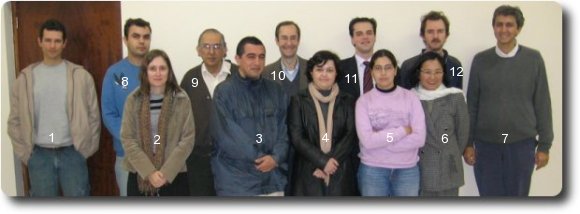
Members of the openModeller community got together for a meeting at the University of São Paulo, Brazil. Attendees provided information about ongoing research into optimisation, architecture, clustering and profiling. Attendees were:
- Renato De Giovanni
- Ana Carolina Lorena
- César Bravo
- Fabiana Santana
- Mariana Ramos Franco
- Prof. Liria M. Sato
- Prof. Pedro Luiz P. Corrêa
- Daniel Assis Alfenas
- Prof. João José Neto
- Prof. Antônio Mauro Saraiva
- Jeferson Martin
- Tim Sutton
Tuesday, June 6, 2006
0.3.4 openModeller GUI available
A new version of the Windows build of openModeller Desktop GUI is available. Note: This does not include the openModeller QGIS plugin for windows which will be made available in a future announcement.
Thursday, August 11, 2005
Major bugfix release 0.3.2
An error during normalization offsets calculation was making DG_GARP and DG_GARP_BS produce null models most part of the time (100% omission on projected maps). Apparently the other algorithms were not affected. This problem was fixed on version 0.3.2 of both the library and the GUI. We recommend all users to upgrade.
Monday, July 18, 2005
Released version 0.3.1
Both the library and the GUI have been "co-released" under the same version number: 0.3.1. There were many changes in the library (code cleanup, bugfixes, new features and performance optimizations).
Changes to the library include:
Changes to the GUI include:
Changes to the library include:
- Reimplemented serialization/deserialization mechanism using generic configuration objects (all available algorithms are now serializable).
- om_console accepts two new keywords "Output model" (file name to store the serialized model) and "Input model" (file name to load a serialized model instead of using "WKT format", "Species file", "Species" and "Map").
- New framework for test cases available (depends on the SWIG/Python interface).
- Moved normalization from the individual raster files to the "environment" object.
- Implemented Model and Algorithm separation (new interface called Model abstracts the portion of Algorithm used for evaluations).
- Implemented reference-counting smart pointers for all major objects.
- Fixed various problems with memory leaks and uninitialized values.
- Removed CSM Kaiser-Gutman from build.
- Removed SWIG/Java binding from build.
- Projected maps now have the mask extent and cell size of a specified "map format".
- Major restructuring of directories, file locations and file names.
Changes to the GUI include:
- Compatibility with the new library version.
- Models are automatically serialized (XML file).
- A new report is generated (and saved in HTML) after each modelling process.
Saturday, July 2, 2005
BDWorld using openModeller in a GRID environment
Demonstration sessions during the BiodiversityWorld (BDWorld) GRID Workshop showed openModeller being used as a GRID component. The workshop has been held at the National e-Science Centre in Edinburgh on June 30th and July 1st, 2005.
BDWorld is developing an advanced GRID-based problem solving environment to facilitate scientific research in biodiversity informatics. Use cases may include modelling species distributions, conservation prioritization and study of evolutionary changes.
BDWorld provides a flexible workflow interface based on Triana with several pre-defined GRID components available. Components can be assembled in many different ways to build customized workflows and achieve the desired results.
BDWorld is developing an advanced GRID-based problem solving environment to facilitate scientific research in biodiversity informatics. Use cases may include modelling species distributions, conservation prioritization and study of evolutionary changes.
BDWorld provides a flexible workflow interface based on Triana with several pre-defined GRID components available. Components can be assembled in many different ways to build customized workflows and achieve the desired results.
Subscribe to:
Posts (Atom)